

Can Obesity Cause Leg Pain? Causes and What Helps
Can being overweight cause leg pain? How obesity affects the knees, veins, lymph flow and arteries, how it differs from lipedema, what helps and when to see a doctor.
On this page
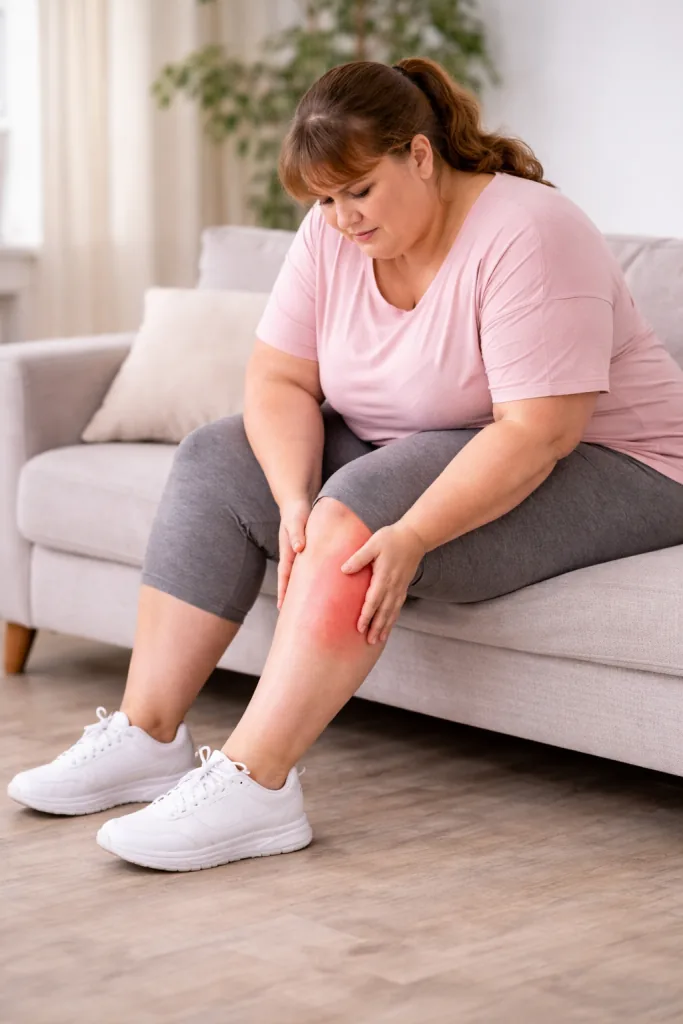
Yes, obesity can contribute to leg pain, in several ways: it puts more load on the knees, raises the pressure in the leg veins, can lead to lymph swelling, and is a risk factor for varicose veins, deep vein thrombosis and peripheral artery disease. Which of these is behind your pain makes a difference, because some causes need a doctor quickly. For knee osteoarthritis, according to IQWiG, even a small weight loss can relieve the knee.
As of October 2026. Sources are linked below. They are mostly German health authorities and medical guidelines, plus the WHO.
Key Takeaways
- Obesity in adults means a BMI of 30 or more, according to the WHO; overweight means 25 or more.
- Knees: in knee osteoarthritis, weight loss with overweight is one of the things that can help, according to IQWiG.
- Veins: according to the German Society of Phlebology and Lymphology (DGPL), extra weight clearly raises the pressure in the ankle veins and can promote and worsen varicose veins.
- Swelling: according to the German Federal Ministry of Health, obesity is a factor that favours lymphedema.
- Thrombosis and arteries: obesity is listed as a risk factor for deep vein thrombosis and for peripheral artery disease.
- Not always obesity: painful, symmetrical fat on the legs that spares the feet can be lipedema, a separate condition.
- Warning signs: one leg suddenly swollen and painful, or breathlessness and chest pain, need a doctor at once, in an emergency 112 (in Germany and the EU).
How Obesity Can Cause Leg Pain
| What hurts | Possible cause | What is known |
|---|---|---|
| Knee, worse when walking or climbing stairs | Knee osteoarthritis | According to IQWiG, the protective cartilage gets thinner, causing pain and restricted movement. With overweight, even a small weight loss can relieve the knee. |
| Heavy, tired, aching legs, worse in the evening, sometimes with visible veins | Varicose veins and chronic venous insufficiency | According to the DGPL, extra weight clearly raises the pressure in the ankle veins. IQWiG and the German Federal Ministry of Health list severe overweight as a risk factor for varicose veins. |
| Swelling that does not go down overnight, feeling of tightness | Lymphedema | According to gesund.bund.de, obesity is a factor that favours lymphedema. The German lipedema guideline describes obesity-associated lymphedema, mainly in the legs. |
| Calf pain when walking that eases when you stand still | Peripheral artery disease | According to gesund.bund.de, severe overweight is one of the factors that raise the risk. |
| One leg suddenly swollen, painful, warm | Deep vein thrombosis | According to gesund.bund.de, obesity is one of the risk factors. See a doctor at once. |
Several causes can occur together. According to the German venous leg ulcer guideline, obesity raises the pressure in the abdomen and with it the pressure in the leg veins, and the reduced mobility that comes with obesity weakens the calf muscle pump. According to the DGPL, people with overweight often move relatively little. That is why a doctor should check the cause rather than putting everything down to weight.
Obesity or Lipedema?
Lipedema is not the same as obesity. According to the German lipedema guideline (English version), lipedema is always painful, affects only the limbs, both sides symmetrically, and leaves the head, neck and trunk out. Obesity, by contrast, also affects the trunk. Both can occur together, and with additional obesity, lymphedema can develop. More in lipedema, lymphedema or obesity: what comes first? and on our lipedema page.
What Helps
- Move regularly. The WHO recommends at least 150 minutes of moderate-intensity physical activity per week for adults. Walking also activates the calf muscle pump. For knee osteoarthritis, according to IQWiG, targeted exercise that keeps cartilage and joint fit is the most important treatment. Exercises in vein exercises.
- Lose weight gradually if you are overweight. For varicose veins, IQWiG and the German Federal Ministry of Health list losing weight if you are overweight among the self-help measures, though it is not yet clear how much it helps. For knee osteoarthritis, IQWiG says weight loss with overweight can help. For people with lymphedema who are overweight, according to gesund.bund.de, weight loss and exercise can be beneficial.
- Raise your legs and avoid long standing and sitting, as IQWiG and the German Federal Ministry of Health list for varicose veins.
- Compression stockings for venous symptoms only after a medical check: according to the German compression guideline, advanced peripheral artery disease is a contraindication (recommendation 31).
- Have the cause checked. Your family doctor is the first point of contact and can refer you on.
When to See a Doctor
| Situation | What to do |
|---|---|
| Breathlessness, chest pain or racing heart | Call 112 at once |
| One leg suddenly swollen, painful or warm | See a doctor at once, suspected thrombosis |
| Leg suddenly cold, pale or numb | Call 112 at once |
| Leg red, warm and painful with fever | See a doctor the same day |
| Calf pain when walking that eases when you stand still | Appointment with your family doctor |
| Swelling that keeps coming back or does not go down overnight | Appointment with your family doctor |
| Knee pain that limits daily life | Appointment with your family doctor |
Frequently Asked Questions
Can being overweight cause leg pain? Yes, it can contribute in several ways: more load on the knees, higher pressure in the leg veins, lymph swelling, and a higher risk of varicose veins, thrombosis and peripheral artery disease. The cause matters, so have persistent pain checked.
Can obesity cause calf pain? It can contribute. Calf pain when walking that eases when you stand still can be a sign of peripheral artery disease, for which severe overweight is a risk factor. A sudden painful, swollen calf on one side can be a deep vein thrombosis and needs a doctor at once.
Can being overweight cause swollen ankles? It can contribute. Extra weight raises the pressure in the ankle veins, according to the DGPL, and obesity favours lymphedema, according to gesund.bund.de. Swollen ankles can also come from the heart, kidneys or medicines, so have them checked. More in swollen legs: causes and what helps.
Will losing weight help my leg pain? It depends on the cause. For knee osteoarthritis, according to IQWiG, even a small weight loss can relieve the knee. For varicose veins, IQWiG and the German Federal Ministry of Health list losing weight among the self-help measures, but whether it eases symptoms is not yet clear. With lipedema, according to the guideline, treating accompanying obesity is an important part of the overall treatment.
Is it obesity or lipedema? Lipedema is always painful, symmetrical and limited to the limbs; the trunk is not affected. Obesity also affects the trunk. Both can occur together. A doctor makes the diagnosis.
How LEVANA Can Help
LEVANA does not make a diagnosis; that remains your doctor's job. The free LEVANA Leg Check™ helps you judge whether to have your legs checked. In daily life the app supports you with reminders to move and exercises for the calf muscles.
Sources
All accessed on 6 October 2026.
- WHO: Obesity and overweight, fact sheet of 8 December 2025: definition of overweight and obesity
- WHO: Physical activity, fact sheet of 26 June 2024: at least 150 minutes per week
- IQWiG, gesundheitsinformation.de: Kniearthrose (knee osteoarthritis), updated 10 April 2024: weight loss and exercise
- IQWiG, gesundheitsinformation.de: Krampfadern (varicose veins): risk factors, what you can do
- German Federal Ministry of Health, gesund.bund.de: Krampfadern: risk factors, losing weight
- German Society of Phlebology and Lymphology (DGPL): Krampfadern: overweight and ankle vein pressure
- German Federal Ministry of Health, gesund.bund.de: Lymphödem: obesity as a favouring factor, weight loss and exercise
- German Federal Ministry of Health, gesund.bund.de: Periphere arterielle Verschlusskrankheit: risk factors
- German Federal Ministry of Health, gesund.bund.de: Tiefe Venenthrombose: risk factors
- AWMF S2k guideline on lipoedema (037-012), English version, 2024: definition, obesity-associated lymphoedema, treating obesity
- AWMF S2k guideline on compression therapy of the limbs (037-005), version 5.1 of 16 July 2026: contraindications (recommendation 31)
- AWMF S2k guideline on venous leg ulcers (037-009), version 4.1 of 30 January 2024: chapter 1.5, obesity-associated chronic venous insufficiency
Related Articles
- Lipedema, lymphedema or obesity: what comes first?
- Heavy legs: causes
- Swollen legs: causes and what helps
- Peripheral artery disease
- Varicose veins
Disclaimer
This article is for general information only and does not replace medical advice, diagnosis or treatment. If one leg suddenly swells, get checked at once; for breathlessness or chest pain, call 112.
Carefully researched by the LEVANA editorial team, supported by our advisory board for movement, nutrition and leg wellness. Meet the advisory board.