

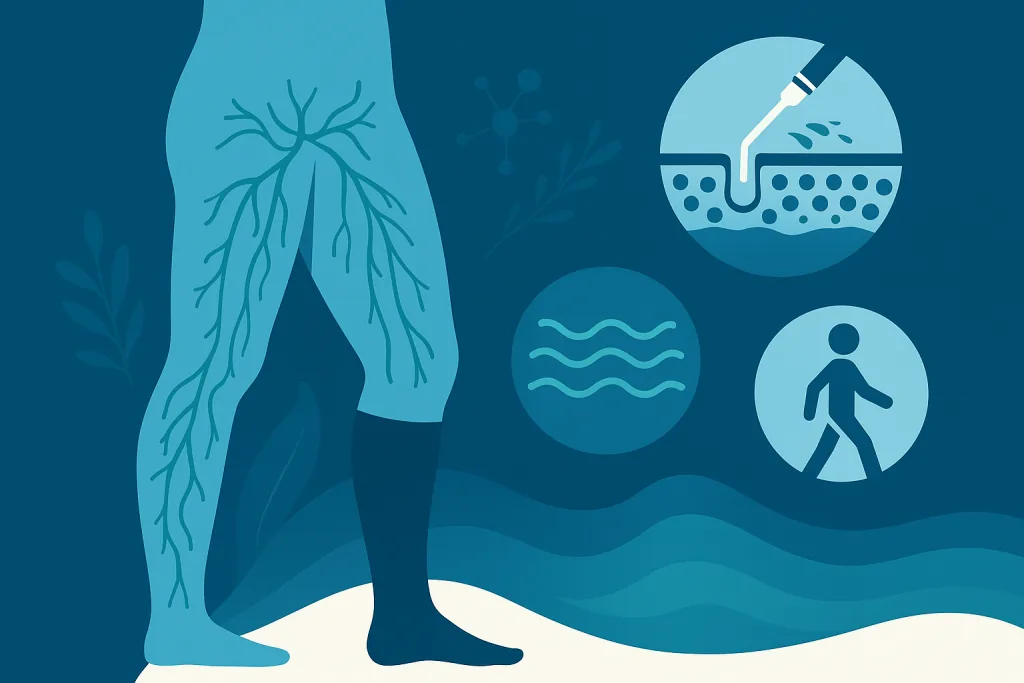
Lipedema (also spelled lipoedema) is a painful, disproportionate and symmetrical build-up of fat in the legs, and sometimes the arms, that affects almost exclusively women. The feet and hands are not affected. What defines it is pain: tenderness to pressure or touch, spontaneous pain or a feeling of heaviness in the affected fat. Without these symptoms, a disproportionate fat distribution is not lipedema. According to the guideline, it almost always begins or gets worse in phases of hormonal change, such as puberty, after pregnancies or around menopause. According to the current German guideline, lipedema is not inevitably progressive, and the stages describe appearance, not severity.
As of October 2026. Sources are linked below.
Key Takeaways
- What it is: a painful, symmetrical, disproportionate increase of fat in the limbs, almost exclusively in women.
- Typical signs: legs (sometimes arms) clearly larger than the trunk, a marked step to the unaffected area (a "cuff"), for example above the ankles, feet and hands spared, pain on pressure or touch, heaviness.
- Not the same as obesity, although many women with lipedema are also overweight, and obesity can make it worse.
- Stages 1 to 3 describe skin and fat; they are not a measure of how bad it is.
- Not automatically progressive: worsening has been linked to weight gain; hormonal changes can also be triggers.
- Treatment: compression and exercise for pain, weight management, psychosocial support, and liposuction if pain persists despite conservative treatment.
What Is Lipedema?
The German S2k guideline on lipedema (AWMF 037-012, 2024) describes lipedema as a painful, disproportionate, symmetrical disorder of fat distribution in the limbs, found almost exclusively in women (recommendation 1.1). The fat can increase evenly over the thighs and/or lower legs, or over the upper and/or lower arms. Typical is a marked step at the border to the unaffected area (a "cuff"), for example above the ankles. The trunk, head and neck are not affected.
According to the guideline, the following count as lipedema symptoms (recommendation 2.1):
- pain on pressure or touch
- spontaneous pain
- a feeling of heaviness
A disproportionate increase in fat in the limbs without these symptoms should not be diagnosed as lipedema (recommendation 2.2). The guideline calls this lipohypertrophy.
Lipedema and obesity
Lipedema is not caused by obesity, and it does not cause obesity. But many women with lipedema are also overweight or obese, and only a minority are of normal weight. Obesity can make lipedema worse. According to the guideline, body mass index (BMI) is not a good measure in lipedema, because the extra fat in the legs inflates it; combining it with the ratio of waist to height (waist-to-height ratio) gives a better picture.
Can you be slim and have lipedema?
Yes. What matters for the diagnosis is not your weight but a disproportionate increase in fat in the legs or arms compared with the trunk, together with pain in that tissue. Only a minority of women with lipedema are of normal weight, but it does occur.
Lipedema or lymphedema?
| Lipedema | Lymphedema | |
|---|---|---|
| What increases | painful fat tissue | lymph fluid, later also hardened tissue |
| Sides | always symmetrical | one-sided or both sides, also uneven |
| Feet and hands | not affected | can be affected |
| Stemmer sign | negative unless lymphedema is added | positive when tissue has hardened |
Pressure pain is typical of lipedema, not of lymphedema. According to the guideline, a lymphedema can develop on top of lipedema on the basis of coexisting obesity.
What Causes Lipedema?
The exact cause is not known. According to the guideline, lipedema almost always first appears, or gets worse, during phases of hormonal change: puberty, after pregnancies and around menopause. According to the guideline, links with female sex hormones are suspected, but robust data are lacking. Lipedema can run in families; first studies point to genetic factors, but the mechanism is unclear.
Stages and Types
The three stages describe the skin and fat. They come from the official German diagnosis codes (ICD-10-GM):
| Stage | Skin surface | Fat tissue |
|---|---|---|
| 1 | smooth | evenly thickened |
| 2 | uneven, wavy | thickened, with nodules |
| 3 | large overhanging folds of skin and fat | marked increase in size |
The guideline is clear that these stages shall not be used as a measure of severity (recommendation 2.4): appearance and pain are not linked, so stage 1 can be painful. "Lumpy" fat shall not be used for diagnosis either (recommendation 2.5). The location (hips, thighs, whole leg, arms, lower legs only) is purely descriptive (recommendation 2.3); it is often given as "type I to V", but the order and numbering differ between authors. More on the stages in our German article Lipödem Stadien 1, 2 und 3.
Does lipedema get worse over time?
Not inevitably. According to the guideline, lipedema shall not be regarded as a categorically progressive disease (recommendation 2.10). In one study cited by the guideline, the condition stayed stable in two thirds of women; in the remaining third, worsening was linked to weight gain. Hormonal changes such as menopause can also act as triggers. With a stable weight, lipedema can remain stable for many years.
Recognizing the Symptoms
- legs, and sometimes arms, clearly larger than the trunk, on both sides
- feet and hands of normal size, typically with a visible "cuff" above them
- pain when pressed or touched, spontaneous pain
- a feeling of heaviness or tension, which can increase over the day
- bruising is often reported, but according to the guideline it cannot be used as a deciding diagnostic sign
If you are also overweight, losing weight through an appropriate diet can reduce leg volume too, according to the guideline (recommendation 10.2). Lipedema can be a heavy emotional burden, and the guideline asks doctors to consider psychosocial factors too (recommendations 8.1 and 8.2).
Getting Diagnosed
Lipedema is diagnosed clinically, through conversation and examination (recommendation 2.12); there is no blood test or scan that proves it. Your doctor will ask about your symptoms and family history, examine your legs and arms, and measure at least weight, height, and waist and hip circumference. Ultrasound can help rule out other causes of swelling, such as vein problems.
Treatment Options
Compression
In diagnosed lipedema, compression shall be used to relieve pain in the affected limbs (recommendation 4.1). It shall be aimed at reducing pain and other symptoms (recommendation 4.3), and patients shall be told that compression does not reduce fat tissue (recommendation 4.4). For long-term use, medical compression stockings should be preferred in routine cases (recommendation 4.2). Which garment is right is decided with your doctor. According to the German compression guideline, flat-knit garments shall generally be prescribed for large differences in circumference, cone-shaped limbs or deep skin folds.
Exercise
Exercising in compression garments, or a training programme, is an important element of pain reduction and shall be part of the overall treatment (recommendation 7.2).
Manual lymph drainage
If compression cannot be used or is not enough on its own, pain can additionally be treated with manual lymph drainage combined with other methods. Its aim in lipedema is not to reduce volume but to ease pain (recommendation 7.1).
Weight and lifestyle
Your doctor shall advise you early about the negative impact of obesity on lipedema and the importance of healthy eating and an active lifestyle (recommendation 10.1). Weight gain is linked to worsening.
Medicines
According to the guideline, treatment with drugs is not considered useful in lipedema. Diuretics ("water pills") shall not be used to treat lipedema, but they may be needed for other medical reasons (recommendation 6.1). Do not stop a prescribed medicine on your own.
Liposuction
According to the guideline, liposuction is the surgical method of choice for a lasting reduction of the affected fat tissue (recommendation 12.1). According to the guideline, the decision shall take into account, among other things, pain that persists despite conservative treatment, complications such as reduced mobility, a particularly careful (critical) decision when the waist-to-height ratio is over 0.55 or the BMI is over 40, and treating any coexisting obesity first (recommendation 12.2). It shall no longer depend on the stage (recommendation 12.3). It is done with tissue- and lymph-vessel-sparing techniques, in one to four sessions for the legs and one or two for the arms (recommendation 12.4).
In Germany: since October 2025, statutory health insurance covers liposuction for lipedema in all three stages if the conditions are met, including six months of continuous, doctor-prescribed conservative treatment without sufficient relief and a BMI of up to 35 (between 32 and 35 only within limits on the waist-to-height ratio). Details are in our German guide Lipödem.
Living with Lipedema
The guideline puts weight on self-management: understanding the condition, setting concrete goals with your care team and taking an active role (recommendation 9.1). The guideline recommends compression and exercise for pain, attention to weight, and psychosocial support where needed.
When to See a Doctor
- if your legs or arms are clearly out of proportion to your trunk and hurt when pressed or touched
- if the swelling changes, appears on one side only, or the feet become involved, which may point to lymphedema
- if pain or the emotional burden affects your daily life
If one leg suddenly swells, hurts and feels warm, that is not lipedema: see a doctor at once, it can be a deep vein thrombosis. For breathlessness or chest pain, call the emergency number (112 in Germany and the EU).
Frequently Asked Questions
What is lipedema? A painful, symmetrical, disproportionate build-up of fat in the legs and sometimes the arms, found almost only in women. The feet and hands are spared. Pain on pressure or touch, spontaneous pain or heaviness are part of the diagnosis.
What does lipedema look like in the legs? Both legs are clearly larger than the trunk, sometimes described as "column legs", with a visible "cuff" just above the ankles while the feet stay slim. In later stages the skin becomes wavy or forms folds, but how the legs look says nothing about how much they hurt.
Can you be skinny and have lipedema? Yes. The diagnosis depends on disproportionate, painful fat in the limbs, not on weight. Only a minority of women with lipedema are of normal weight, but slim women can have it.
Does diet or exercise get rid of lipedema? If you are also overweight, losing weight through an appropriate diet can reduce leg volume, according to the guideline (recommendation 10.2). Compression does not reduce fat. Weight gain has been linked to worsening, and exercise in compression is an important part of pain reduction.
Is lipedema progressive? Not inevitably. The guideline says it shall not be regarded as categorically progressive. Worsening has been linked to weight gain; hormonal changes can also be triggers.
What is the difference between lipedema and lymphedema? Lipedema is painful fat, always symmetrical, with the feet and hands spared. Lymphedema is a build-up of lymph fluid that can be one-sided and can involve the feet or hands. Both can occur together.
How LEVANA Can Help
LEVANA does not make a diagnosis. In daily life the app can support you with reminders for compression and exercise. If you are unsure whether to have your legs checked, the free LEVANA Leg Check™ gives a first structured overview, without a diagnosis.
Sources
All accessed on 6 October 2026.
- AWMF S2k guideline Lipoedema (037-012), English version, German Society of Phlebology and Lymphology, version 5.0 of 22 January 2024: definition, symptoms, stages, progression, diagnosis, compression, exercise, lymph drainage, medicines, obesity, self-management, liposuction (recommendations as cited)
- AWMF S2k guideline on compression therapy of the limbs (037-005), version 5.1 of 16 July 2026 (German): chapter 8.5 lipedema; recommendation 4 flat knit
- BfArM, ICD-10-GM 2026, block E70 to E90: codes E88.20 to E88.22, stage definitions
- G-BA, reasons for the quality-assurance directive on liposuction of 17 July 2025: six months of conservative treatment, BMI limits
- G-BA, decision of 17 July 2025: liposuction for lipedema covered by German statutory health insurance
Related Articles
Disclaimer
This article is for general information only and does not replace medical advice, diagnosis or treatment. If you have persistent or severe symptoms, please see a doctor.
Take the next step in the app
Start with the free Leg Check for a structured overview, or register to follow a guided programme.