

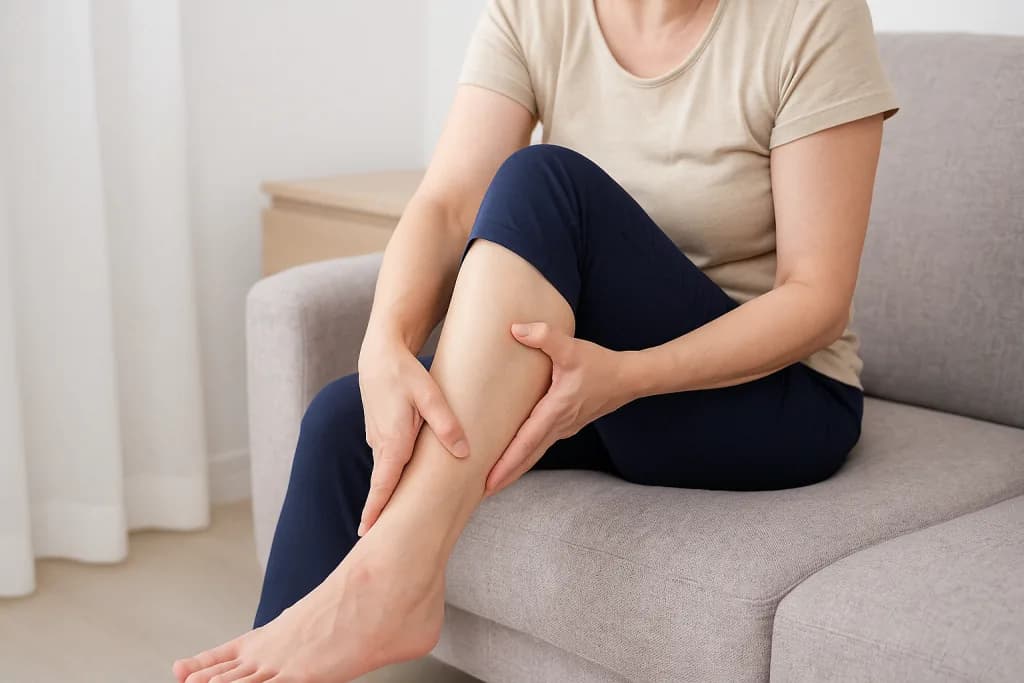
Chronic venous insufficiency (CVI) is treated with three building blocks: medical compression, movement for the calf muscle pump and, if leaking superficial veins are the cause, a procedure on those veins. According to the guideline, compression is the standard conservative treatment for a leg ulcer and reduces swelling. Treating the varicose veins lowers the risk that a healed leg ulcer opens again. The tendency to CVI cannot be cured, but you can influence its course.
As of October 2026. Sources are linked below. They are mostly German medical guidelines (AWMF).
Key Takeaways
- What is CVI? The consequences of a permanently disturbed backflow in the leg veins, stages C3 to C6 in the CEAP classification: swelling, skin changes, leg ulcer.
- How common? In the Bonn Vein Study, one in five women and one in six men had CVI.
- Cause: usually leaking vein valves with varicose veins, sometimes the result of an earlier thrombosis.
- Treatment: compression, movement, raising the legs, skin care and, where it makes sense, treating the varicose veins.
- Leg ulcer: according to the guideline, compression speeds up healing, and a procedure on the superficial veins shall be aimed for early.
- Emergency: one leg suddenly swollen? Have it checked by a doctor at once. For breathlessness or chest pain, call 112 (in Germany and the EU).
What Is Chronic Venous Insufficiency?
The leg veins carry blood back to the heart against gravity. Vein valves work like non-return valves to prevent backflow, and when you walk, the calf muscles squeeze the deep veins. If the valves no longer close properly, or a vein has been damaged by a thrombosis, the pressure in the veins stays raised. Over time fluid leaks into the tissue, and later the skin changes.
Specialists classify this with the international CEAP classification. CVI covers stages C3 to C6:
| Stage | What is visible |
|---|---|
| C3 | swelling (oedema) at the ankle and lower leg |
| C4 | skin changes: brownish discolouration, eczema, hardening, a crown of fine veins at the edge of the foot |
| C5 | healed leg ulcer |
| C6 | open leg ulcer (venous leg ulcer) |
Stages C0 to C2, meaning no visible signs, spider veins and varicose veins, do not yet count as CVI. The full classification and the early signs are explained in Chronic venous insufficiency: recognising the early signs.
Causes
- Varicose veins: in the Bonn Vein Study, after 6.7 years, 19.8 percent of people with varicose veins outside the large trunk veins and 31.8 percent of people with varicose veins of the large trunk veins developed CVI.
- An earlier deep vein thrombosis: according to the guideline, a post-thrombotic syndrome with swelling and skin changes develops in about 30 percent of cases. More in the guide to deep vein thrombosis.
- Risk factors for varicose veins: older age, female sex, pregnancies, varicose veins in the family, severe overweight and jobs with a lot of standing.
Diagnosis
The standard examination is duplex ultrasound. It shows which veins leak, where blood flows backwards and whether the deep veins are clear. The possible treatment depends on this. For a leg ulcer, according to the guideline, a detailed medical history and a physical examination form the basis of diagnosis, and accompanying lymphoedema shall also be taken into account.
Treatment: What Helps According to the Guidelines
Medical compression
Compression is the basic building block of CVI treatment.
- Swelling and symptoms: the current German compression guideline (AWMF 037-005, 2026) states that medical compression stockings can improve venous symptoms, swelling and quality of life in chronic venous disease, even at low pressure. Where possible, however, according to the guideline, treating the varicose veins works better than compression alone.
- Skin changes: according to the compression guideline, one study showed that hardening of the skin (lipodermatosclerosis) in severe CVI can improve with compression.
- Leg ulcer: the German venous leg ulcer guideline (AWMF 037-009, 2024) calls compression the standard conservative treatment; it speeds up healing (recommendation 16). After initial decongestion with compression bandages, according to the guideline, patients should switch to two-layer ulcer stocking systems (recommendation 22).
- After healing: patients shall be advised to wear medical compression stockings (recommendation 50) to prevent a recurrence (recommendation 51).
Your doctor decides which class and type of compression you need. Contraindications must be ruled out first, for example a severe arterial circulation disorder or severe heart failure, because then compression can cause harm (recommendation 17). In Germany, with a prescription you get the stockings from a medical supply store, and with statutory health insurance you usually pay only the statutory co-payment. If putting them on is difficult, according to the guideline, suitable donning and doffing aids should be prescribed (recommendation 68).
Movement
According to the guideline, compression only works fully when the muscle and joint pumps are working. People with a leg ulcer shall therefore be guided to move regularly, for example with walking exercises and foot exercises (recommendation 27), and stay active after healing too (recommendation 55). According to the guideline, limited ankle mobility is a risk factor for a leg ulcer becoming chronic, and a stiff ankle shall be mobilised while compression continues (recommendation 28). You can find exercises in our article on vein exercises.
Treating the cause: a procedure on the varicose veins
If leaking superficial veins are the cause, the abnormal backflow can be switched off with heat from inside, sclerotherapy or surgery. The venous leg ulcer guideline recommends:
- With a leg ulcer, treatment of the backflow in the superficial veins shall be aimed for early, weighing risks and benefits and taking your wishes into account, so that the wound heals faster (recommendation 31).
- After healing, a weakness of the superficial veins shall be treated to lower the risk of recurrence, even if the deep veins also leak (recommendation 52).
The procedures are described in the guide to varicose veins.
Skin care
With a leg ulcer, according to the guideline, individually adapted skin care with hypoallergenic products shall be recommended (recommendation 62), because contact allergies to care and wound products occur. Itchy, reddened or weeping areas on the lower legs should be seen by a doctor.
Weight
With obesity, after a healed leg ulcer, normalising weight shall be recommended to prevent a recurrence (recommendation 56).
What about vein medicines?
For so-called vein medicines (phlebotonics), a Cochrane review (2020) shows that they probably reduce swelling slightly, but hardly change quality of life and cause side effects somewhat more often than placebo. The review mainly examined medicines. For food supplements a benefit is not proven. More in Rutin and sweet clover for the veins: what is proven?.
What You Can Do Yourself
- Wear compression consistently if it has been prescribed, in summer too. Tips in compression stockings in summer.
- Move a lot: walking, climbing stairs, rising onto your toes now and then.
- Raise your legs several times a day.
- Watch and care for your skin: show discolouration, hardening, itching or small wounds on the lower legs to a doctor early.
- Have varicose veins checked if there are already signs of CVI.
When to See a Doctor
| Situation | What to do |
|---|---|
| Breathlessness, chest pain or racing heart, especially with a swollen leg | Call 112 at once, suspected pulmonary embolism |
| One leg suddenly swells, or only one side swells | See a doctor at once, suspected thrombosis |
| Leg red, warm and painful, with or without fever | See a doctor at once, suspected thrombosis or erysipelas |
| Leg suddenly cold, pale or numb | See a doctor at once, with severe pain call 112 |
| A wound on the lower leg that does not heal | Promptly see a doctor, possible start of a leg ulcer |
| Skin on the lower leg discoloured, hardened or itchy | Appointment with a vein specialist |
| Ankles swell again and again | Appointment with your family doctor or a vein practice |
Persistent swelling of both legs can also come from the heart or kidneys. According to the German Society for Vascular Surgery and Vascular Medicine, a check by your family doctor is then the first step.
Frequently Asked Questions
Can chronic venous insufficiency be cured? The tendency to leaking veins cannot be cured. But if varicose veins are the cause, a procedure can switch off the abnormal backflow, and compression, movement and skin care keep symptoms and skin changes in check. After a leg ulcer, according to the guideline, compression and treating the varicose veins lower the risk of recurrence.
Does CVI always get worse? Not necessarily, but the risk is real. CVI can progress over years, but it does not have to. In the Bonn Vein Study, 0.7 percent of the population had an open or healed leg ulcer, 2.7 percent among 70 to 79 year olds. With known CVI, according to the guideline, the risk of getting worse is about 4.3 percent per year. Compression, movement and treating varicose veins target exactly this.
Do I have to wear compression stockings for life? Your doctor decides based on the stage and course. After a healed leg ulcer, the guideline recommends continuing to wear medical compression stockings to prevent a recurrence.
Which compression class do I need for CVI? Your doctor decides. According to the compression guideline, symptoms and swelling can improve even at low pressure.
Does health insurance pay for treatment? In Germany, medical compression stockings are available on prescription. With statutory health insurance you then usually pay only the statutory co-payment. Whether your insurer covers a particular procedure on varicose veins is best clarified in advance with the practice and the insurer.
Can I exercise with CVI? Yes, according to the guideline, movement is part of the treatment. Walking, cycling and exercises for the calves and ankle support the muscle pump. If you wear compression, wear it then too, unless your doctor says otherwise.
How LEVANA Supports You
LEVANA does not make a diagnosis; that remains your doctor's job. The free LEVANA Leg Check™ helps you judge whether to have your legs checked. In daily life the app supports you with reminders for compression and movement, exercises for the calf muscles and knowledge about skin care.
Sources
All accessed on 6 October 2026.
- AWMF S2k guideline on diagnosis and treatment of venous leg ulcers (037-009), version 4.1 of 30 January 2024: recommendations 1, 2, 16, 17, 22, 27, 28, 31, 50, 51, 52, 55, 56, 62, 68; frequency of leg ulcers, course of CVI
- AWMF S2k guideline on compression therapy of the limbs (037-005), version 5.1 of 16 July 2026: chapter 8.1 (chronic venous disease)
- AWMF S2k guideline on diagnosis and treatment of varicose veins (037-018), as of March 2019, expired and under revision: Bonn Vein Study, risk factors, course
- AWMF S2k guideline on venous thrombosis and pulmonary embolism (065-002), 2023: post-thrombotic syndrome
- Robert Koch Institute: Federal Health Reporting, issue 44, venous diseases of the legs, 2009: Bonn Vein Study
- IQWiG, gesundheitsinformation.de: Krampfadern (varicose veins): risk factors
- Martinez-Zapata MJ et al.: Phlebotonics for venous insufficiency. Cochrane Database of Systematic Reviews 2020
- German Society for Vascular Surgery and Vascular Medicine: swollen legs in summer, June 2026: warning signs, swelling of both legs
Related Articles
- Chronic venous insufficiency: recognising the early signs
- Varicose veins: causes, symptoms and treatment
- Deep vein thrombosis
- Compression stockings in summer
- Vein exercises
Disclaimer
This article is for general information only and does not replace medical advice, diagnosis or treatment. If a leg suddenly swells, get checked at once; for breathlessness or chest pain, call 112.
Take the next step in the app
Start with the free Leg Check for a structured overview, or register to follow a guided programme.