

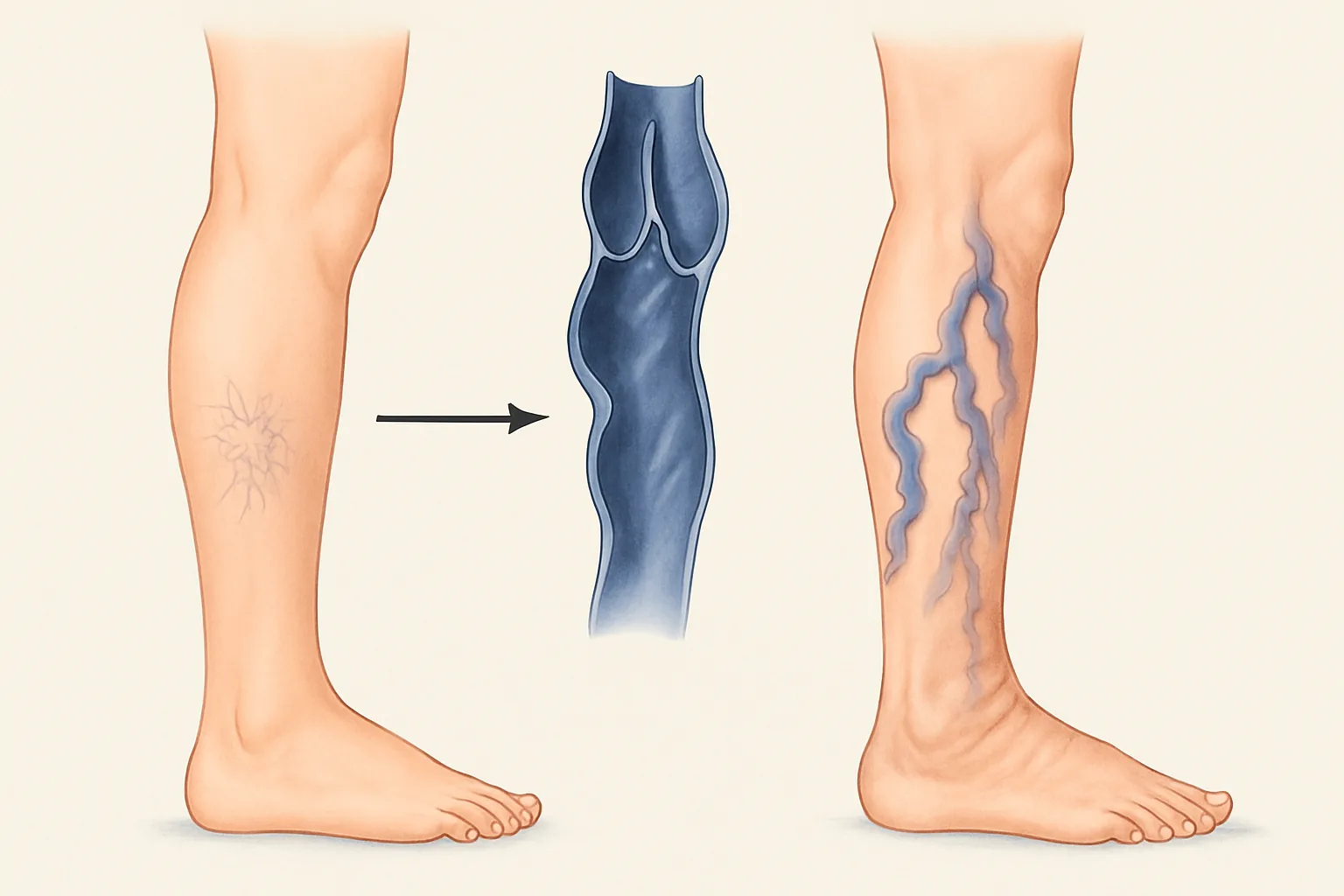
Varicose veins are permanently widened, often knotty and twisted veins just under the skin, usually on the calves or the inner side of the legs. They develop when the vein valves no longer close properly and blood pools in the superficial leg veins. About one in five adults develops varicose veins at some point, women more often than men. For many they are mainly a cosmetic issue, but they can also cause heavy, swollen legs and night-time calf cramps. They do not go away by themselves, with one exception: varicose veins from pregnancy often shrink back after birth.
As of October 2026. Sources are linked below. They are German: the Institute for Quality and Efficiency in Health Care (IQWiG), the German Federal Ministry of Health, the German Society of Phlebology and Lymphology (DGPL) and the German compression guideline.
Key Takeaways
- What are varicose veins? Widened superficial leg veins in which blood flows towards the feet instead of the heart because the valves leak.
- How common: about 20 percent of adults, more with age.
- Typical symptoms: heavy, tired, tense legs, swelling at the ankles, itching, night-time calf or foot cramps, worse in the evening and in warm weather. Many people have no symptoms.
- Diagnosis: examination while standing and colour duplex ultrasound.
- Treatment: movement and compression for symptoms; varicose veins can only be removed with a procedure: heat from inside (laser, radiofrequency), sclerotherapy or surgery.
- Most common complication: an open leg ulcer, in 3 to 6 percent of people with untreated varicose veins.
- Emergency: if a varicose vein bleeds, press firmly on the spot, raise the leg and get medical help at once, for heavy bleeding via 112. If one leg suddenly swells and hurts, have it checked at once: it can be a deep vein thrombosis.
How Do Varicose Veins Develop?
The legs have deep veins between the muscles and superficial veins under the skin. When you walk, the calf muscles squeeze the deep veins and push the blood upwards, the so-called muscle pump. Vein valves act like non-return valves so that the blood does not fall back.
If the vein wall and valves weaken, the valves no longer close fully. Blood then flows towards the feet in the superficial veins. The wall is overloaded and stretches, so further valves start to leak. The DGPL describes this as a domino effect that ends in the visible varicose vein.
Vein specialists distinguish two forms:
- Primary varicose veins are by far the more common form. There is no single trigger; several risk factors work together.
- Secondary varicose veins usually develop after a deep vein thrombosis: if outflow through the deep veins is blocked, blood diverts into the superficial veins and overloads them.
What raises the risk:
- older age
- family history: if one parent has varicose veins the risk rises, if both do, even more
- pregnancies
- severe overweight
- jobs with long periods of standing
- lack of exercise
- a previous deep vein thrombosis
Varicose Veins That Appear Suddenly
Varicose veins usually develop over years. If you notice them suddenly, there can be several reasons:
- Rule out the dangerous cause first. If veins suddenly stand out on one leg and the leg is also swollen, painful or warm, it can be a deep vein thrombosis. Have it checked at once.
- The cause was invisible before. The large trunk veins (the saphenous veins) lie so deep that you usually cannot see them from outside even when widened. According to the DGPL, spider veins and reticular veins can be the result of such an invisible trunk vein problem. Often it only becomes visible at the side branches.
- Pregnancy. Hormones and more blood volume strain the veins, and many pregnant women develop varicose veins. They often shrink back by themselves after birth.
- After a thrombosis. Secondary varicose veins can develop over time after a deep vein thrombosis.
- Warmth. In warm weather symptoms often increase, and varicose veins tend to be more noticeable then.
When not to wait:
- If a vein is suddenly red, warm, hard and painful, it can be superficial thrombophlebitis. Varicose veins increase the risk, and according to the DGPL the clot can grow into the deep veins. Have it checked promptly by a doctor.
- If one leg suddenly swells, hurts, is warm or bluish, see a doctor or go to an emergency department at once: it can be a deep vein thrombosis. For breathlessness or chest pain, call 112.
Symptoms: How to Recognise Varicose Veins
Typical are bluish or purple, swollen, bulging veins visible through the skin, often knotty, mostly on the calves or the inner legs. Possible symptoms:
- heavy, tired legs and a feeling of tension that eases when you raise your legs
- swelling, especially at the ankles
- tight or itchy skin
- night-time calf or foot cramps, also pain at night
- a restless feeling in the legs
Symptoms usually get worse towards the evening, after long sitting or standing, in warm weather and, in women, often during menstruation. Important: how noticeable varicose veins look says little about how much they bother you. Inconspicuous varicose veins can cause a lot of discomfort, while large knots sometimes cause none. And these symptoms also occur with other conditions and even in healthy people.
The CEAP stages
Vein specialists classify findings in seven stages using the CEAP classification:
| Stage | What the doctor sees |
|---|---|
| C0 | no visible or palpable vein changes |
| C1 | spider veins and reticular veins |
| C2 | varicose veins |
| C3 | swelling (oedema) |
| C4 | skin changes: brownish discolouration, eczema, hardening |
| C5 | healed leg ulcer |
| C6 | open leg ulcer |
From C3 doctors speak of chronic venous insufficiency. Varicose veins can be its cause or its result.
Are Varicose Veins Dangerous?
Usually not. The most common complication is an open leg ulcer: according to IQWiG it develops in about 3 to 6 percent of people with untreated varicose veins. Vein inflammation, thrombosis and bleeding are rarer. The DGPL also stresses that varicose veins do not go away by themselves and tend to get worse over the years, so an early check is worthwhile.
When to See a Doctor
| Situation | What to do |
|---|---|
| Bleeding from a varicose vein | At once: press firmly on the spot, raise the leg, cover it and get medical help; for heavy bleeding call 112 |
| One leg suddenly swells, hurts, is warm or bluish | See a doctor at once, suspected thrombosis. For breathlessness or chest pain call 112 |
| Red, warm, painful vein | Promptly, ideally the same day: suspected superficial thrombophlebitis |
| A wound at the ankle that appeared without an injury, or one that has not healed after 2 weeks | Promptly see a doctor |
| Marked leg swelling that developed slowly, or a rash over the varicose veins | Promptly see a doctor |
| Varicose veins with symptoms, swelling or skin changes | Appointment with your family doctor or a vein specialist (phlebologist) |
| Varicose veins that only bother you cosmetically | Advice is possible, not urgent |
Diagnosis
First your doctor asks about symptoms, previous illnesses and risk factors. The legs are examined while you stand, because the veins are then well filled. According to the DGPL, the method of choice is colour duplex ultrasound: a painless scan that shows the superficial and deep veins, the valves, the direction of blood flow and any old or new clots. It also clarifies whether the varicose veins are primary or secondary and which treatment is an option.
Treatment
Whether, when and how to treat is decided jointly by you and your doctor. What counts is the form and stage, your symptoms, other conditions and how much the varicose veins bother you. Treatment can also make sense if it is mainly the appearance that weighs heavily on you.
Relieving symptoms: movement and compression
- Movement: walking, brisk walking, jogging or vein exercises activate the muscle pump. Break up long standing and sitting where possible, raise your legs when sitting and do not cross them. You can find exercises in our article on vein exercises.
- Medical compression: the current German compression guideline (AWMF S2k 037-005, July 2026) states that compression stockings can improve venous symptoms, swelling and quality of life, even at low pressure. IQWiG, on the other hand, considers the benefit for varicose vein symptoms not yet reliably proven. The guideline also states that where possible, removing the varicose vein works better than compression alone.
- Vein creams, tablets and food supplements: according to IQWiG their effect is not proven, including extracts of horse chestnut or red vine leaf.
According to the DGPL, movement and compression are meant to relieve symptoms and slow progression. The widened vein itself remains.
Removing varicose veins: the procedures
| Procedure | How it works |
|---|---|
| Radiofrequency ablation | A thin catheter is pushed into the vein, and radio waves seal it from inside with heat |
| Endovenous laser therapy | As above, with laser light as the heat source |
| Sclerotherapy | A liquid or foam is injected into the vein, which scars and closes. Liquid for spider veins, foam for larger veins |
| Stripping | The trunk vein is pulled out fully or partly through incisions in the groin or the back of the knee |
| Phlebectomy | Smaller varicose veins are removed piece by piece through tiny incisions of a few millimetres |
| Vein-sparing procedures (CHIVA, valvuloplasty) | The vein stays; the abnormal backflow is tied off or the valve is made tight again with a cuff |
According to IQWiG, varicose veins are now often closed with heat, because this leads to complications less often than surgery. After sclerotherapy, brownish marks can appear at the injection sites, which usually fade within weeks to months. Is it a problem to lose the vein? According to the DGPL not with primary varicose veins: because blood flows the wrong way in a varicose vein, other veins have long taken over its job. That is why an ultrasound first checks that the deep veins are clear.
When treatment should be planned soon: according to the DGPL, a procedure should be planned within the next weeks to months if swelling, skin changes or a leg ulcer appear, or after vein inflammation or bleeding. Even then, according to the DGPL, there is enough time to decide calmly with a vein specialist, and compression is usually used first.
Prevention: What You Can Do
You cannot change age or family history. According to the DGPL, there is therefore no sure way to prevent varicose veins. What can lower the risk and ease symptoms:
- Move a lot, as often as possible in daily life.
- Break up long periods of standing and sitting, take a few steps in between.
- Raise your legs when sitting and do not cross them.
- Lose excess weight: according to the DGPL it raises the pressure in the ankle veins.
- Compression in standing jobs: according to the guideline it can reduce swelling and symptoms. That it prevents varicose veins is not proven. Discuss with your doctor whether it makes sense for you.
More everyday tips in preventing varicose veins.
Frequently Asked Questions
Do varicose veins go away on their own? No, with one exception. According to the DGPL, varicose veins do not shrink back by themselves and tend to get worse. Only varicose veins from pregnancy often disappear in the months after birth.
Why do I suddenly have varicose veins? Usually the veins were weakened for a while, often in a deeper trunk vein that cannot be seen from outside. Varicose veins often become noticeable during pregnancy, in warm weather or years after a thrombosis. If a vein is suddenly red, warm and painful or a leg suddenly swells, have it checked by a doctor at once.
Can home remedies get rid of varicose veins? No. Movement, raising the legs and compression can ease symptoms, but the widened vein remains. According to IQWiG, an effect of creams, tablets and herbal vein remedies is not proven. A varicose vein can only be removed with a procedure.
Which doctor treats varicose veins? The first point of contact is usually your family doctor. Specialists are doctors with an additional qualification in phlebology.
Does health insurance pay for treatment? That depends on the procedure and the insurer. According to IQWiG, not every German statutory health insurer pays for every treatment, so it is worth asking yours in advance.
Do varicose veins come back after treatment? Usually varicose veins and symptoms are clearly better after treatment. But the tendency remains, so according to the DGPL, regardless of the method, some people develop varicose veins again years later. Movement and a normal weight can help but are no sure protection.
Is a varicose vein dangerous if it is thick and knotty? Not automatically: size says little about how much it bothers you. But thick knots close under the skin can be injured and bleed more easily. It becomes dangerous with redness, warmth and pain, bleeding, a wound at the ankle or a suddenly swollen leg. Then get checked promptly, at once for sudden swelling.
How LEVANA Can Help
LEVANA does not make a diagnosis; that remains your doctor's job. The free LEVANA Leg Check™ helps you judge whether to have your legs checked. In daily life the app supports you with calf-muscle exercises, reminders to move and knowledge about compression.
Sources
All accessed on 6 October 2026.
- IQWiG, gesundheitsinformation.de: Krampfadern (varicose veins)
- German Federal Ministry of Health, gesund.bund.de: Krampfadern
- German Society of Phlebology and Lymphology (DGPL): Krampfadern
- AWMF S2k guideline on compression therapy of the limbs (037-005), version 5.1 of 16 July 2026, chapter 8.1
Related Articles
- Spider veins or varicose veins: the difference
- Preventing varicose veins
- Chronic venous insufficiency: early signs
- Deep vein thrombosis
- How your veins work
Disclaimer
This article is for general information only and does not replace medical advice, diagnosis or treatment. For a bleeding varicose vein, a suddenly swollen leg or breathlessness, get help at once, in an emergency via 112.
Take the next step in the app
Start with the free Leg Check for a structured overview, or register to follow a guided programme.