

Lymphedema is a chronic swelling that develops when lymph fluid cannot drain properly and builds up in the tissue, often in the arms or legs. It is divided into stages 0 to III: from a stage with no visible swelling, through a soft swelling that goes down when the limb is raised, to a hard, deforming swelling, often with skin changes. The standard treatment is complete decongestive therapy (CDT), made up of manual lymphatic drainage, compression, skin care, exercise and education. Lymphedema stays for life, but with adequate treatment its progression can be prevented.
As of October 2026. Sources are linked below. They are mostly German: the German Federal Ministry of Health and the German medical guidelines (AWMF).
Key Takeaways
- What is lymphedema? Swelling caused by blocked lymph drainage, because lymph vessels or lymph nodes do not work properly or are damaged.
- Primary or secondary: congenital and genetic, or acquired, most often after cancer and its treatment, for example removal of lymph nodes or radiotherapy.
- Stages: 0 (no visible swelling) to III (hard, deforming swelling).
- Symptoms: swelling, a feeling of tightness and heaviness, pain, skin changes, restricted movement.
- Treatment: CDT in two phases, first decongestion, then maintenance. Surgery only if this has not helped enough after 6 months.
- Warning signs: redness, warmth, pain and fever can be erysipelas (a skin infection): have it checked by a doctor the same day; with high fever and chills, rapidly spreading redness or confusion, call 112 (in Germany and the EU).
What Is Lymphedema?
Lymph fluid flows through lymph vessels throughout the body. Among other things it carries proteins, salts and immune cells and drains fluid from the tissue. If lymph vessels or lymph nodes are damaged, the lymph backs up and swelling develops. The trapped fluid is rich in protein. In advanced stages the tissue hardens, and the swelling can hardly be pressed in with a finger anymore.
According to gesund.bund.de, lymphedema is a chronic condition that can occur at any age. In principle any part of the body can be affected, often the arms or legs.
Primary and secondary lymphedema
- Primary lymphedema: genetic. It affects about one in 6,000 newborns, girls ten times more often than boys.
- Secondary lymphedema: acquired and much more common, affecting an estimated 0.1 to 2 percent of people in industrialised countries. The most common causes are cancer and cancer treatments such as removal of lymph nodes or radiotherapy. Injuries and other conditions can also trigger it.
The Stages of Lymphedema
The stages describe the tissue. The German lymphedema guideline (AWMF 058-001, as of 2017, expired and under revision) classifies them as follows:
| Stage | What happens |
|---|---|
| 0 (latent stage) | no visible swelling yet, but lymphoscintigraphy can already be abnormal |
| I (spontaneously reversible) | soft swelling that goes down when the limb is raised |
| II (not spontaneously reversible) | swelling with tissue changes; raising the limb no longer removes it |
| III | hard, deforming swelling, sometimes lobe-shaped, sometimes with typical skin changes |
The German diagnosis code system ICD-10-GM also codes acquired lymphedema (I89.0-) of the arms and legs by stage I to III. The latent stage falls under "other lymphedema" there.
What stage II means: from here, the swelling no longer goes away completely when you raise the limb, because the tissue has already changed. According to the guideline, the aim of treatment is to bring the lymphedema back to a swelling-free state or a lower stage. According to gesund.bund.de, with adequate treatment even pronounced lymphedema can recede.
Symptoms and Consequences
According to gesund.bund.de, common symptoms are:
- swelling
- a feeling of tightness and heaviness
- pain
- skin changes
- restricted movement
Over time the skin can become thicker and firmer, change colour and form wart-like changes. The guideline also names an increased susceptibility to erysipelas and to fungal infections, because the immune defence in the congested tissue is impaired. That is why skin care is a fixed part of treatment.
The Stemmer Sign
When lymphedema is suspected, doctors check, among other things, the Stemmer sign: they try to lift the skin over the base of the second or third toe or the second or third finger into a fold. If the hardened skin can barely be lifted, or not at all, the sign counts as positive. It points to hardening of the tissue, as is typical of lymphedema. A negative sign does not reliably rule out lymphedema, though. That is why the diagnosis is made by a doctor, not by a self-test.
Lymphedema, Lipedema or Something Else?
| Lymphedema | Lipedema | |
|---|---|---|
| What swells? | lymph fluid, later also hardened tissue | fatty tissue, painful |
| Sides | one side or both, also unequal | always symmetrical |
| Feet and hands | can be affected, for example with box-shaped toes | not affected |
| Stemmer sign | positive with hardening; a negative sign does not rule it out | negative unless lymphedema develops as well |
According to the lipedema guideline, obesity-associated lymphedema can develop when obesity is also present. More in lipedema, lymphedema or obesity. Vein disorders can also make legs swell, see chronic venous insufficiency.
Diagnosis
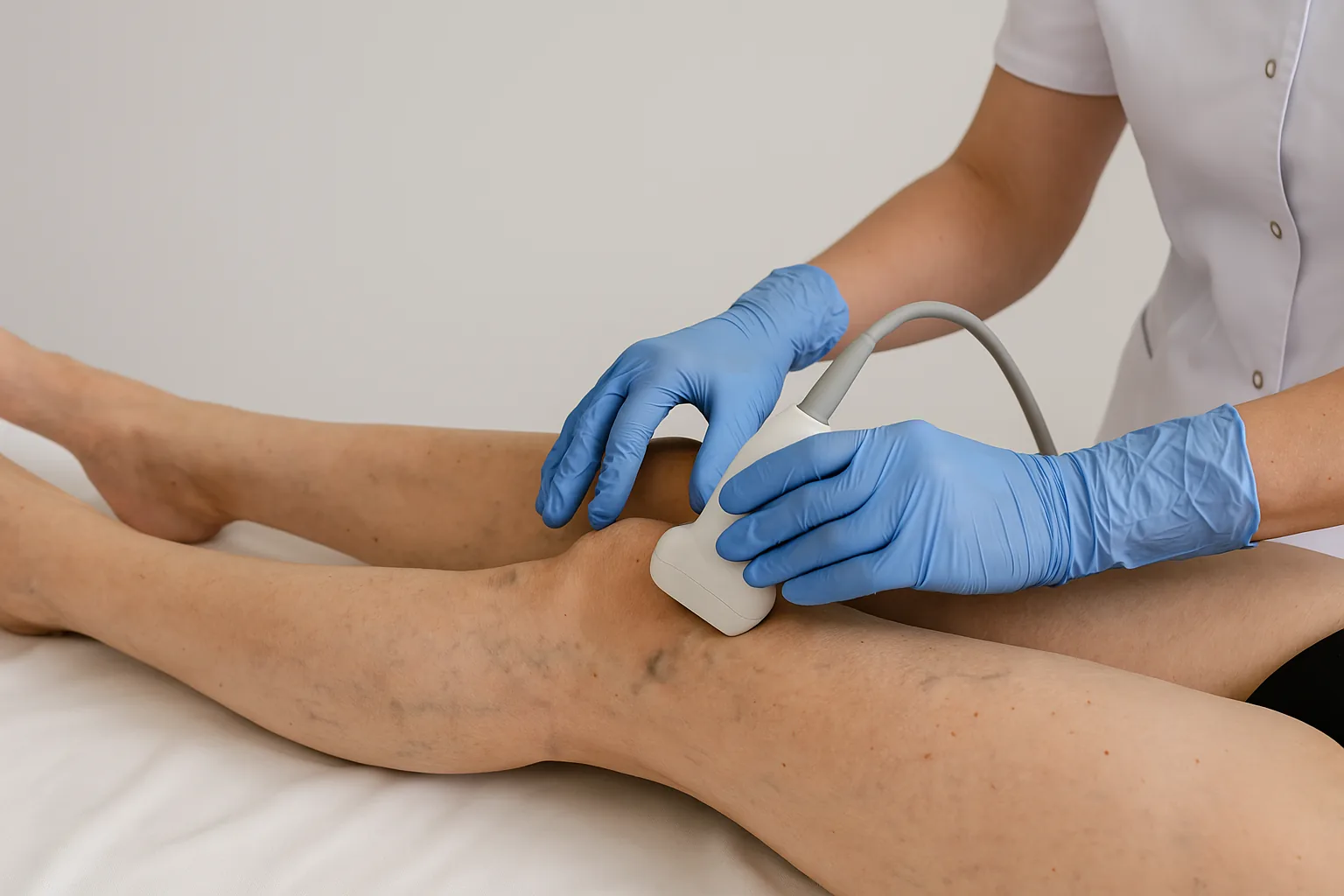
According to gesund.bund.de, the doctor asks about lymphedema or vascular disease in the family, operations, previous illnesses and past or current cancer. The swelling and the skin are examined, and according to the guideline the Stemmer sign as well. If the diagnosis is still unclear, ultrasound, lymphoscintigraphy (which makes lymph transport visible) or other imaging can be used, and genetic tests if primary lymphedema is suspected.
Treatment: Complete Decongestive Therapy (CDT)
According to the guideline, the standard treatment is CDT. It consists of five coordinated building blocks:
- Skin care, including treatment of skin problems if needed
- Manual lymphatic drainage, a special massage that stimulates lymph flow
- Compression with multi-layer bandages and lymphological compression garments
- Movement and exercise, which support decongestion
- Information and training in self-treatment
Two phases
- Phase I, decongestion: all building blocks are applied once or twice a day where possible, in specialised facilities, as an outpatient or inpatient.
- Phase II, maintenance and optimisation: the building blocks are continued according to the findings to keep the result. Depending on the course, phase I may have to be repeated.
Compression
According to the German compression guideline (AWMF 037-005, 2026), compression is a fixed part of CDT. It reduces swelling and maintains the decongested state. In stages I and II, compression class 2 is usually enough; in stage III a higher pressure is often needed. Especially with pronounced lymphedema, according to the guideline, made-to-measure flat-knit garments are not just preferable but necessary, for example with unusual leg shapes, large differences in circumference or when toes or fingers also need to be covered. Your doctor decides which class and type of garment. According to the guideline, flat-knit garments should always be made to measure.
If lymphedema of an arm or leg is not adequately controlled under CDT, according to the German guideline on intermittent pneumatic compression (AWMF 037-007), device-based compression with air sleeves (intermittent pneumatic compression) should be added. It can also be considered in addition to CDT in other cases.
When CDT is not suitable, or only with limits
According to gesund.bund.de, these include heart failure, an acute deep vein thrombosis and acute severe erysipelas. Your doctor checks this before treatment.
Weight and exercise
Especially for people with lymphedema who are overweight, weight loss and exercise for endurance, mobility and strength can be beneficial.
Surgery
According to gesund.bund.de, surgery is only an option if conservative treatment has not helped enough after 6 months.
What You Can Do Yourself
- Wear compression consistently, as prescribed.
- Care for and check your skin daily, and have small injuries, cracks and fungal infections treated early.
- Stay active, for example with exercises or rehabilitation sport.
- Learn self-treatment, as shown to you in training.
- Have accompanying conditions treated, such as diabetes or a vein disorder, which can further impair lymph flow.
When to See a Doctor
| Situation | What to do |
|---|---|
| Breathlessness, chest pain or racing heart | Call 112 at once |
| An arm or leg suddenly swells, hurts or is warm | See a doctor at once, suspected thrombosis |
| Skin red, warm, painful, sometimes with fever and feeling unwell | See a doctor the same day, suspected erysipelas |
| High fever with chills, rapidly spreading redness or confusion | Call 112 at once |
| Swelling of an arm or leg after cancer treatment | Raise it with your doctor soon |
| Swelling that no longer goes away completely when the limb is raised | Appointment with your family doctor or a lymphology practice |
Frequently Asked Questions
Can lymphedema be cured? According to gesund.bund.de, lymphedema stays for life. But with adequate treatment its progression can be prevented, and even pronounced lymphedema can recede. According to the guideline, the aim of treatment is a swelling-free state or a lower stage.
What does stage 2 lymphedema mean? In stage II the tissue has already changed. The swelling no longer goes away completely when the limb is raised. According to the guideline, the aim of decongestive therapy is to bring it back to a swelling-free state or a lower stage.
How is lymphedema treated? With complete decongestive therapy (CDT): skin care, manual lymphatic drainage, compression, exercise and education, first to decongest, then to maintain. Surgery is only an option if this has not helped enough after 6 months.
Do I have to wear compression for life? According to gesund.bund.de, lymphedema stays for life, and according to the guideline, compression is also part of the maintenance phase of CDT, because it keeps the decongested state. From stage II onwards, according to the guideline, compression is indicated long term. How long and in what form is decided by your doctor.
Does health insurance pay for lymphatic drainage? In Germany, your doctor can prescribe manual lymphatic drainage and compression garments for lymphedema. With statutory health insurance you then usually pay only the statutory co-payment.
What is lipo-lymphedema? Lipedema with lymphedema added. According to the lipedema guideline, such lymphedema can develop on the basis of accompanying obesity. In the diagnosis code system the two are coded separately.
What is idiopathic edema? According to the lipedema guideline, idiopathic edema, also called fluid retention syndrome, is a condition of its own: symmetrical swelling that increases during the day and can also affect the feet, hands, abdomen or face. According to the guideline, it must not be confused with lipedema and can occur together with it. Like any unexplained swelling, it should be checked by a doctor.
How LEVANA Supports You
LEVANA does not replace lymphological treatment. In daily life the app can support you with reminders for compression, skin care and exercise.
Sources
All accessed on 6 October 2026.
- German Federal Ministry of Health, gesund.bund.de: Lymphödem (lymphedema): causes, frequency, symptoms, course, diagnosis, CDT, contraindications, surgery
- AWMF S2k guideline on diagnosis and treatment of lymphedema (058-001), as of 2017, expired and under revision: stages, complications, Stemmer sign, CDT and its phases, treatment goals
- AWMF S2k guideline on compression therapy of the limbs (037-005), version 5.1 of 16 July 2026: chapter 8.4 lymphedema, compression classes, flat knit
- AWMF S1 guideline on intermittent pneumatic compression (037-007), 2025: recommendation 1 (limb lymphedema)
- BfArM, ICD-10-GM 2026, block I80 to I89: lymphedema by stage
- German Social Code, Book V, § 61: co-payments: statutory co-payment for therapies and medical aids
- AWMF S2k guideline on lipedema (037-012), 2024: obesity-associated lymphedema
Related Articles
- Lipedema
- Lipedema, lymphedema or obesity: the difference
- Lipedema and lymphedema: therapy, surgery and aftercare
- Chronic venous insufficiency
Disclaimer
This article is for general information only and does not replace medical advice, diagnosis or treatment. With redness, warmth and fever in a swollen arm or leg, get checked the same day; for breathlessness or chest pain, call 112.
Take the next step in the app
Start with the free Leg Check for a structured overview, or register to follow a guided programme.